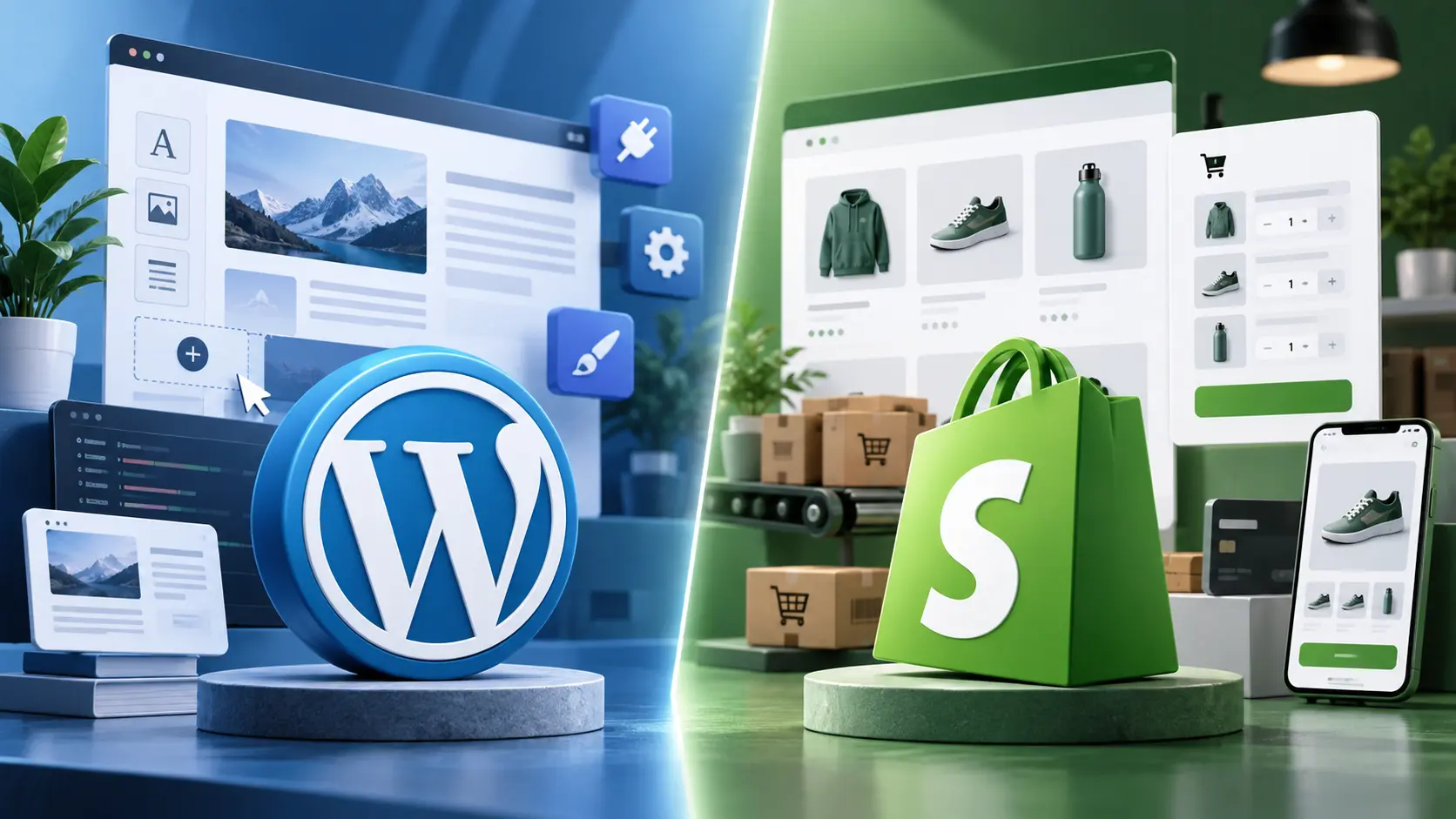
You’ve got a business to run, and somewhere on your to-do list is “sort out the website” except every agency, forum thread, and YouTube video seems to land on a different answer. One client tells you Shopify was the best decision they ever made. Another swears by WordPress and won’t touch anything else. Neither is wrong; they’re usually just describing different businesses.
We build and optimise sites on both platforms for UK businesses at Iqora Digital, and the honest answer to wordpress vs shopify is: it depends on whether you’re selling products, publishing content, or both and how much control you want over the technical side. This guide breaks down pricing, SEO performance, and ecommerce capability so you can make the call with actual information instead of platform loyalty.
WordPress vs Shopify: The Quick Answer
- Choose Shopify if you’re launching a product-based store, want hosting, security, and checkout handled for you, and would rather pay a predictable monthly fee than manage a developer.
- Choose WordPress (with WooCommerce for selling) if content marketing and organic search are core to your growth plan, you want full ownership of your site’s code and data, or your business model is more complex than a straightforward product catalogue.
Neither platform is objectively “better” they’re built around different priorities. Here’s the breakdown behind that recommendation.
What’s the Real Difference Between WordPress and Shopify?
WordPress is free, open-source content management software. It doesn’t include hosting, security, or a shopping cart out of the box you (or your developer) add those through hosting providers and plugins like WooCommerce. That flexibility is exactly why WordPress powers such a large share of the web.
Shopify is a fully hosted, subscription-based ecommerce platform. Hosting, security, checkout, and payment processing are bundled into one monthly fee, and it’s built specifically for selling products rather than general-purpose publishing.
WordPress vs Shopify Pricing: What You’ll Actually Pay
Shopify’s pricing is simpler to quote upfront because it’s a fixed monthly subscription, while WordPress costs are spread across hosting, themes, and plugins which makes total cost of ownership easy to underestimate on either side.
| WordPress + WooCommerce | Shopify | |
| Core software | Free | Paid subscription (tiered plans) |
| Hosting | Separate cost (from a few pounds/month for shared hosting to more for managed WordPress hosting) | Included |
| Checkout & security | Via plugins, largely free | Included |
| Themes | Free to premium (one-off cost) | Free to premium (one-off cost) |
| Transaction fees | None from WooCommerce itself | None with Shopify Payments; a fee applies if you use an external payment processor |
| Ongoing maintenance | Your responsibility (or your agency’s) | Handled by Shopify |
Shopify’s published plans and WooCommerce’s plugin ecosystem both change fairly often, so always check current pricing directly on Shopify’s pricing page and WooCommerce’s official site before budgeting figures quoted in comparison articles (including this one) can go stale within months.
The general pattern holds either way: WordPress tends to cost less at small scale if you’re comfortable with some technical setup, while Shopify trades a higher fixed cost for far less time spent on maintenance.
Is WordPress or Shopify Better for SEO?
This is the question we get asked most, and it’s genuinely close but the two platforms are strong in different areas.
Where WordPress has the edge:
- Deeper control over URL structure, site architecture, and technical SEO settings
- A far more capable content system for blogs, guides, and long-form landing pages useful if organic content is a real growth channel for you, not just a checkbox
- No restrictions on SEO plugins, schema markup, or custom code
Where Shopify has the edge:
- SEO fundamentals (site speed, mobile responsiveness, clean code, SSL) are handled for you by default
- Simpler setup for basic on-page SEO if you don’t want to touch technical settings at all
- Built-in performance and security that indirectly supports rankings, without needing a developer
If your growth plan leans on wordpress vs shopify seo performance specifically meaning you plan to publish regularly, target informational search terms, and build topical authority WordPress’s content infrastructure generally gives you more room to grow. If your priority is a fast, technically sound store without ongoing SEO investment, Shopify’s out-of-the-box setup is genuinely competitive. Neither platform is inherently penalised or favoured by Google; the outcome comes down to how the site is built and maintained on top of it.
WordPress Ecommerce vs Shopify: Selling Products
When people ask about wordpress ecommerce vs shopify, they’re really asking about WooCommerce vs Shopify, since WordPress alone isn’t a shopping cart.
WooCommerce (on WordPress) suits you if:
- You already have a WordPress site and don’t want to migrate
- Your catalogue or checkout logic is unusual and needs custom development
- Content and product pages need to work together closely (e.g. a blog-driven store)
- You have access to a developer for setup and ongoing maintenance
Shopify suits you if:
- You want to launch quickly without managing hosting or plugins
- You’d rather pay one predictable fee than piece together a tech stack
- You’re prioritising a large app marketplace and proven checkout conversion over deep customisation
- You don’t currently have in-house technical support
Some businesses run both: a WordPress site for content and brand authority, with Shopify handling checkout in the background. It’s a more complex setup, but it captures WordPress’s content strength alongside Shopify’s transaction reliability.
A Quick Decision Checklist
- Is content marketing and organic search central to how you plan to grow? → Leans WordPress
- Do you want hosting, security, and checkout bundled into one monthly fee? → Leans Shopify
- Do you have a developer or agency for ongoing site maintenance? → Either works, but it unlocks more from WordPress
- Is your main goal to launch a straightforward product catalogue fast? → Leans Shopify
- Does your business model need custom logic beyond a standard shop (memberships, bookings, complex content)? → Leans WordPress
- Do you want the lowest possible fixed monthly cost, accepting more setup work? → Leans WordPress
Frequently Asked Questions
Is WordPress or Shopify better for SEO?
Both can rank well. WordPress generally offers more flexibility for content-driven SEO strategies and technical customisation, while Shopify handles core technical SEO factors like site speed and security by default with less setup required. The better performer usually comes down to execution, not the platform alone.
Is Shopify cheaper than WordPress?
Not necessarily. Shopify’s monthly subscription is predictable and all-inclusive, while WordPress costs are spread across hosting, themes, and plugins. At small scale, a well-managed WordPress site can cost less overall; at larger scale, or if you’d rather not manage maintenance yourself, Shopify’s bundled pricing can work out simpler to budget for.
Can I switch from WordPress to Shopify later, or vice versa?
Yes, though migrating an ecommerce store between platforms involves moving product data, redirecting URLs to preserve SEO rankings, and rebuilding design elements. It’s a manageable project but not a simple export-import, so it’s worth planning for if you’re not fully committed to one platform yet.
Do I need coding skills to use either platform?
No, but WordPress generally expects more comfort with technical setup, plugins, and occasional troubleshooting unless you have a developer or agency managing it. Shopify is built to be usable without coding knowledge, though customisation beyond its themes and apps often still benefits from developer support.
Which platform is better for a small UK business just starting out?
It depends on the business. A service-based business or one planning to grow through content and search traffic often does better starting on WordPress. A business focused purely on selling a product catalogue, with limited time for technical setup, often finds Shopify faster to launch and easier to maintain from day one.
Choosing between WordPress and Shopify is really a decision about how your business wants to grow through content and search, through fast product sales, or some mix of both. If you’d like a second opinion on which platform fits your specific goals, our web development services team can walk through your requirements, and our SEO services team can tell you exactly what either platform would need to actually rank. Get in touch and we’ll point you in the right direction no pressure to pick one over the other before you’re ready.